
| The Survival Foods And Gardening Section |
THE FANTASTIC FLY!
by Kurt Saxon
From THE SURVIVOR; Volume Six: Issue 12
You’ve probably never given it a thought but the common house-fly is a
potential asset to anyone with chickens to feed. The following ideas will enable you to
cut your feed bills to zero and even give you feed to sell. (See also THE SURVIVOR Vol. 1,
pages 12, 39 and 110).
The common house-fly and the larger blue and green thoraxes
flies are
wildly prolific. Estimates have been made that if one pair of flies should be allowed to
breed with no deaths, in one year they would weigh as much as the Earth itself.
Consider, one fly weighs about a grain with 1500 grains to the ounce. A
female will lay about 120 eggs. I don’t know the ratio of females to males but let’s say
half, or 60 females. The cycle from egg to egg-laying female is 10 days to two weeks.
Say you captured a male and female hung together in the act of mating.
Put them in a cloth covered box with a moist slice of baloney and keep it in a warm place.
In a few hours the female will lay her 120 eggs. Soon thereafter the eggs will hatch into
maggots. After eating the constantly moistened baloney for a few days the maggots will
pupate and soon again, adult flies will emerge from the pupa cases and commence to mate
and eat, eat and mate, and just lay oodles more eggs. (No need to capture a pair of flies
in the act of mating. Just get three or four flies and one or more of them will certainly
be females)
If you should expand your operation, in four weeks you would have 3600
females. Two more weeks and you would have 216,000. Another two weeks, 12,960,000. We’re
just counting probable females, remember? In 12 weeks, or three months, would you believe
47,256,000,000?!
That approximates 31,504,000 ounces, or 1,969,000 pounds, or 984 tons!
You would run out of baloney in no time. But going back to Survival City and the
animal and human waste, there would be no running out.
We have already slated the waste from the chickens, rabbits and other
livestock for earth- worms. But the human waste would be for flies.
Most state laws say that human waste is always waste and cannot be used
for growing food directly. This is wise as cities and towns put so many chemicals down
their sewers that any end product would be carcinogeous. But in Survival City, nothing but
human waste would be put in the sewer system.
Even so, esthetics dictate against using it to directly fertilize
plants. The Chinese have used “night soil” directly on plants for thousands of
years. Some fields have up to six feet of topsoil. All night soil is avidly
collected. Rurals even put up attractive outhouses along roads to entice passersby. So
intent are the Chinese on utilizing night soil that a constipated Chinese is flogged and
given high colonies.
The human waste for fly food would first go through a grinder similar
to that described for all Survival City’s plant and animal waste. This is because maggots
can’t eat what they can’t get into their little mouths. After grinding the waste would go
into a special digester which would generate methane, used as fuel. The methane process
would generate enough heat to kill all bacteria and further break down the waste.
What would be left would be a vat of slurry covered by about two thirds
of its volume of mineral-rich water. The water would be siphoned off into algae troughs
and the slurry would be fed to the flies.
A fly-feeding unit I’ve designed would provide 120 one square yard by
four inches deep plastic trays. As shown, they would be on racks, preferably of
sheet-metal and would be 12 high with four inches of space between.
The fly room would be 15 by 10 feet and would hold 10 racks. It would
be fully enclosed by window screen to keep the flies inside. In the bottom part of each
tray would be a hole with a patch of rubber with a slit in it through which a nozzle would
be inserted. The same kind of slit rubber patch would be over holes in the screen adjacent
to each tray.
As the maggots ate themselves to pupahood they would rise to the top to
pupate. It wouldn’t do to put the new slurry on top of the pupas, thus killing them, so
the slurry would have to well up from beneath. Two inches from the bottom of each tray
would be fixed one square yard of rigid plastic with holes spaced every square inch.
Thus, as the slurry was consumed and the level went down, the slurry
tube would be inserted through both rubber patches into the bottom half of the tray.
Starting at the far end of the tray, the tube would be worked from side to side and
withdrawn as the slurry welled up through the holes and caused the top level of slurry to
rise, refilling the tray.
At one end of the screened-in fly room would be a screened section two
feet wide by four feet long, at the bottom of which would be a drawer covering that area.
Hanging from its center would be s system of electrified wires too close together for a
fly to get through.
Flies touching the wires would be electrocuted and would drop through
the slit of the electrified screens making a “V” just above the drawer. There
would be a three eigths of an inch slit at the bottom of the “V” so the chances
of a live fly getting into the drawer would be small.
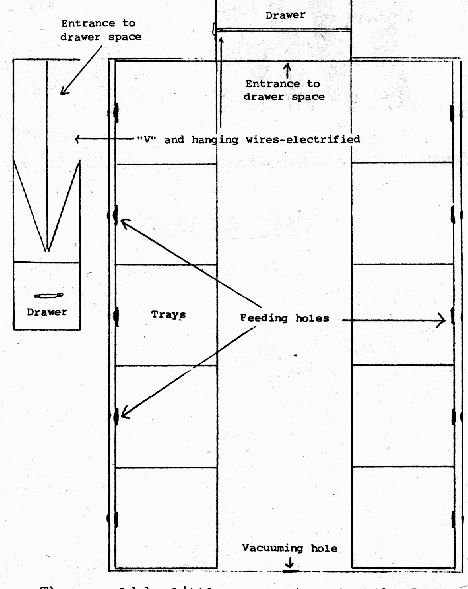
There would be little reason to enter the fly room. At the
end opposite the drawer would be another slit rubber patch for inserting a ten foot long
tube to vacuum out any flies dying naturally.
If the unit were properly maintained, the drawer should be filled with
dead flies several times a day.
Getting back to the algae, I’ve reprinted the findings of Robert Lawlor
in his excellent article first printed the Dec. 1974 issue of ALTERNATE SOURCES OF ENERGY.
I don’t understand his thinking as he added urea and even carbon dioxide to his tanks,
plus aeration. In summer, most ponds and ditches are covered by an inches thick layer of
algae. It grows quite well naturally, taking its carbon dioxide from the water plus
utilizing what minerals are in the water. If a portion of the algae were harvested each
day and minerals were added, the crop would be much larger than it is naturally.
The mineral-rich soup siphoned off the slurry would supply all the
minerals the algae needed to divide twice each day.
I suggest three foot wide, 20 feet long, one foot deep wooden,
plastic-lined troughs filled with the water. The light from the sun or fluorescent lights,
plus a possible heat source under the plastic should supply all the algae wanted.
The harvested algae could be mixed with the dead flies, dried and
pelletized or broken up. As chicken feed it would supply all the protiens, vitamins and
minerals required, even by chicks.
Although flies are known to be carriers of germs, this is only because
wild flies seek decaying matter for food and for egg laying. These domesticated flies,
feeding and laying their eggs on the nearly sterile slurry would be as germ-free as one
could reasonably want.
My system is for producing in bulk to feed commercial flocks or to
sell. But it could be scaled down to fit the needs of the individual.
Nor would one be confined to human waste. Any manure, chicken, rabbit,
pig, cow, horse, etc. would do. For a clean product, however, it is urged that the manure
first be subjected to the methane extraction process. This would
not only provide free gas for the house but would produce a finer, cleaner slurry for the
flies.
ENCYCLOPEDIA BRITANICA 1892
THE
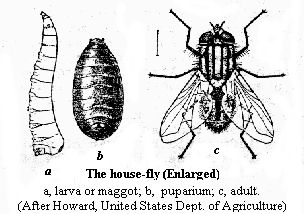
HOUSE-FLY
The minute dull chalky white eggs (usually about 120 in number),
elongate oval and cylindrical in shape, are laid by the parent fly in crevices of fresh
manure in or about stables,—heat, and especially moisture, being required for their
development. The larval are hatched in twenty-four hours, and pass through three stages,
averaging from five to seven days in all; in the second of its stages, the larva has been
observed to increase by one-third of its length in twenty-four hours. They resemble those
of the well-known meat fly, Ca.lliphora vomitoria, but are smaller, longer, more
slender, transparent, smooth, and shining, and regularly conical. The prop-leg at the apex
is also much smaller, and cannot be seen from above when the larva is in motion. They cat
the decaying parts of the manure, leaving the bits of hay and straw. The
puparium, or
pupa- case, is a quarter of an inch long, cylindrical, and dark brown, closely resembling
that of Stomoxys calcitrons, from which it chiefly differs in the larger and squarer anal
spiracles and the smoother apex. The enclosed pupa is of the usual type of the
cyclorhaphous Diptera, and is readily distinguishable from that of Siomoxys by its broad
spatulate labium and curved maxillary palpi; it rests in the case with the hard framework
of the jaws of the old larva skin next tho ventral side; and when the fly pushes its way
out, after remaining from five to seven days as a pupa, the upper end of the case splits
off just behind the suture between the thorax and abdomen. The term “pupa” is
here used in a general sense, since intermediate stages of development (variously called
“pseudo-nymph” or “semi-pupa”) in that condition occur in the
Muscidoe, as in Hymenoptcra, Colcopicra, &c.On leaving the pupa-case, the fly runs about with its wings soft,
small, and baggy, pressed to the side of the body, much as in the pupa. It is pale, with
the colours not set, and the membranous portion of its forehead constantly distends with
air as the fly moves, being connected with the trachere. From Mr Lowne’s observations on
the anatomy of the blow-fly, this organ is evidently employed for pushing away the end of
inc puparum when the pupa slips out of its case.The whole period of evolution being thus from ten to fourteen days
only, and the number of eggs laid by each female fly so numerous, it will be readily seen
tliat any slight personal inconveunience to man, as produced by the habits of the perfect
insect, are much more than compensated for by the unceasing labours of its larvae as
scavengers; the benefit being the more direct as the work is invariably done close to
human habitations. The workings of the law of nature, by which an excess of increase in
any one species is checked, are conspicuously shown in the case of this insect. Not only
do the ordiuary parasites of its own class (some Hymenopterous, and in one recorded
instance Coleopterous) attack it in its earlier stages, but certain common birds arc
particularly addicted to it in the perfect stalte (in which also a Chelifer, a minute
European representative of the scorpions, has also been found parasitically attached to
it). The vegetable world also supplies some lethal agents in tlie shape of fungi (notably
Empusa, muscoe), individuals destroyed by which are constantly to be, seen in autumn
unable to move, and distended or ruptured by the expansion of the internal growth, the
white spores of which are finally to bo observed scattered round their victim.Trivial as the house-fly may appear even to entomologists, it is to be
noted that recent obsurvations by the German biologist Wcissman on its development have
resulted in his discovery of its possessing “imaginal discs” in the early larval
state—a structure deemed of sufficient value to suggest a new division of the whole
Insecta into “Discota” and ” Adiscota.”