| Welcome To Our “Selected Works of Kurt Saxon & Other Fine Folk” Section |
Part Two Of
“THE SLAVE TRADE IN THE CONGO
BASIN”
All tribes I have known have an idea of immortality. They
believe that death leads but to another life, to be continued under the same
conditions as the life they are now leading; and a chief thinks that if when he
enters into this new existence that if he is accompanied by a sufficient
following of slaves he will be entitled to the same rank in the next world as he
holds in this. From this belief emanates one of their most barbarous
customs–the ceremony of human sacrifices upon the death of any one of
importance. Upon the decease of a chief, a certain number of his slaves are
selected to be sacrificed, that their spirits may accompany him to the next
world. Should this chief possess thirty men and twenty women, seven or eight of
the former and six or seven of the latter will suffer death. The men are
decapitated, and the women are strangled. When a woman is to be sacrificed she
is adorned with bright metal bangles, her toilet is carefully attended to, her
hair is neatly plaited, and bright-colored cloths are wrapped around her. Her
hands are then pinioned behind, and her neck is passed through a noose of cord;
the long end of the cord is led over the branch of the nearest tree, and is
drawn taut at a given signal; and while the body is swinging in mid-air its
convulsive movements are imitated with savage gusto by the spectators. It often
happens that a little child also becomes a victim to this horrible ceremony, by
being placed in the grave alive, as a pillow for the dead chief. These
executions are still perpetrated in all the villages of the Upper Congo.
But the life of the slave is not only forfeited at the death
of the chief of the tribe in which fate has cast his lot. Let us suppose that
the tribe he is owned by has been maintaining an internecine warfare with
another tribe in the same district. For some reason it is deemed politic by the
chief to bring the feud to an end, and a meeting is arranged with his rival. At
the conclusion of the interview, in order that the treaty of peace may be
solemnly ratified, blood must be spilled.
A slave is therefore selected, and the mode of torture
preceding his death will vary in different districts. In the Ubangi River
district the slave is suspended head downwards from the branch of a tree, and
there left to die. But even more horrible is the fate of such a one at Chumbiri,
Bolobo, or the large villages around Irebu, where the expiatory victim is
actually buried alive with only the head left above the ground. All his bones
have first been crushed or broken, and in speechless agony he waits for death.
He is usually thus buried at the junction of two highways, or by the side of
some well-trodden pathway leading from the village; and of all the numerous
villagers who pass to and fro, not one, even if he felt a momentary pang of
pity, would dare either to alleviate or to end his misery, for this is forbidden
under the severest penalties.
HOW THE NATIVES ARE ENSLAVED
The varying fortunes of tribal warfare furnish the markets
with slaves whose cicatrization marks show them to be members of widely
differing families and distant villages. But there are some tribes, and these
the most inoffensive and the most peaceful, whose weakness places them at all
times at the mercy of their more powerful neighbors. Without exception the most
persecuted race in the dominions of the Congo Free State are the Balolo tribes,
inhabiting the country through which the Malinga, Lupuri, Lulungu, and Ikelemba
rivers flow. I may here mention the the prefix “Ba” in the language of
these people implies the plural; for instance, Lolo would mean one Lolo–Ba-lolo
signifying Lolo people. These people are naturally mild and inoffensive. Their
small, unprotected villages are constantly attacked by the powerful roving
tribes of the Lufembé and Ngombé. These two tribes are voracious cannibals.
They surround the Lolo villages at night, and at the first signs of dawn pounce
down upon the unsuspecting Balolo, killing all the men who resist and catching
all the rest. They then select the stronger portion of their captives, and
shackle them hand and foot to prevent their escape. The remainder they kill,
distributing the flesh among themselves.
As a rule, after such a raid they form a small encampment;
they light their fires, seize all the bananas in the village, and gorge upon the
human flesh. They then march over to one of the numerous slave-markets on the
river, where they exchange the captives with the slave-traders of the Lulungu
River for beads, cloth, brass wire, and other trinkets. The slave-traders pack
the slaves into their canoes and take them down to the villages on the Lulungu
River where the more important markets are held. Masankusu, situated at the
junction of the Lupuri and Malinga tributaries, is by far the most important
slave-trading center. The people of Masankusu buy their slaves from the Lufembé
and Ngombé raiders, and sell them to the Lulungu natives and traders from down
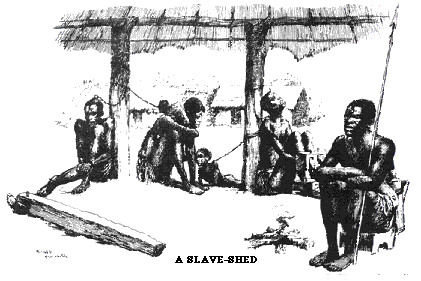
river. The slaves are exhibited for sale at Masankusu in long sheds, or rather
under simple grass roofs supported on bare poles. It is heartrending to see the
inmates of one of these slave-sheds. They are huddled together like so many
animals.
IN THE SLAVE SHED
The accompanying pictures, from sketches which I took at
Masankusu, will give some idea of the suffering which is endured by captives in
numberless slave-markets. (Note: These illustrations are reproduced in Kurt
Saxon’s book ROOT ROT. See details at the end of this article.) They are hobbled
with roughly hewn logs which chafe their limbs to open sores; sometimes a whole
tree presses its weight on their bodies while their necks are penned into the
natural prong formed by its branching limbs. Others sit from day to day with
their legs and arms maintained in a fixed position by rudely constructed stocks,
and each slave is secured to the roof-posts by a cord knotted to a cane ring
which either encircles his neck or is intertwined with his woolly hair. Many die
of pure starvation, as the owners give them barely enough food to exist upon,
and even that they grudge them. These hungry creatures form indeed a truly
pitiable sight. After suffering this captivity for a short time they become mere
skeletons. All ages, of both sexes, are to be seen: mothers with their babes;
young men and women; boys and girls; and even babies who cannot yet walk, and
whose mothers have died of starvation, or perhaps been killed by the Lufembé.
One seldom sees either old men or old women; they are all killed in the raids:
their marketable value being very small, no trouble is taken with them.
Witnessing groups of these poor, helpless wretches, with
their emaciated forms and sunken eyes, their faces a very picture of sadness, it
is not difficult to perceive the intense grief that they are inwardly suffering;
but they know too well it is of no use to appeal for sympathy to their merciless
masters, who have been accustomed from childhood to witness acts of cruelty and
brutality, so that to satisfy their insatiable greed they will commit
themselves, or permit to be committed, any atrocity, however great. Even the
pitiable sight of one of these slave-sheds does not half represent the misery
caused by this traffic–homes broken up, mothers separated from their babies,
husbands from wives, and brothers from sisters. When last at Masankusu I saw a
slave woman who had with her one child, whose starved little body she was
clutching to her shrunken breast. I was attracted by her sad face, which
betokened great suffering. I asked her the cause of it, and she told me in a
low, sobbing voice the following tale:
“I was living with my husband and three children in an
inland village, a few miles from here. My husband was a hunter. Ten days ago the
Lufembé attacked our settlement; my husband defended himself, but was
overpowered and speared to death with several of the other villagers. I was
brought here with my three children, two of whom have already been purchased by
the traders. I shall never see them any more. Perhaps they will kill them on the
death of some chief, or perhaps kill them for food. My remaining child, you see,
is ill, dying from starvation; they give us nothing to eat. I expect even this
one will be taken from me today, as the chief, fearing lest it should die and
become a total loss, has offered it for a very small price. As for myself,”
said she, “they will sell me to one of the neighboring tribes, to toil in
the plantations, and when I become old and unfit for work I shall be
killed.”
There were certainly five hundred slaves exposed for sale in
this one village alone. Large canoes were constantly arriving from down river,
with merchandise of all kinds with which they purchased these slaves. A large
trade is carried on between the Ubangi and Lulungu rivers. The people inhabiting
the mouth of the Ubangi buy the Balolo slaves at Masankusu and the other
markets. They then take them up the Ubangi River and exchange them with the
natives there for ivory. These natives buy their slaves solely for food. Having
purchased slaves they feed them on ripe bananas, fish, and oil, and when they
get them into good condition, they kill them. Hundreds of the Balolo slaves are
taken into the river and disposed of in this way each month. A great many other
slaves are sold to the large villages on the Congo, to supply victims for the
execution ceremonies.
Much life is lost in the capturing of slaves, and during
their captivity many succumb to starvation. Of the remainder, numbers are sold
to become victims to cannibalism and human sacrifice ceremonies. There are few
indeed who are allowed to live and prosper.
CANNIBALISM
Cannibalism exists among all the peoples on the Upper Congo
east of 16 E. longitude, and is prevalent to an even greater extent among the
people inhabiting the banks of the numerous affluents. During a two months’
voyage on the Ubangi River I was constantly brought into contact with
cannibalism. The natives there pride themselves upon the number of skulls they
possess, denoting the number of victims they have been able to obtain. I saw one
native hut, around which was built a raised platform of clay a foot wide, on
which were placed rows of human skulls , forming a ghastly picture, but one of
which the chief was very proud, as he signified by the admiring way he drew my
attention to the sight. Bunches of twenty and thirty skulls were hung about in
prominent positions in the village. I asked one young chief, who was certainly
not more than twenty-five years old, how many men he had eaten in his village,
and he answered me thirty. He was greatly astonished at the horror I expressed
at his answer. In one village again, as I had bought a tusk of ivory, the
natives thought perhaps I might buy skulls, and several armfuls were brought
down to my boat within a few minutes.
I found trading somewhat difficult on this river, as the
standard of value on the Ubangi was human life–human flesh. I have been asked
on several occasions to barter a man for a tusk of ivory, and I remember that at
one village the natives urged me to leave one of my boat’s crew in exchange for
a goat. “Meat for meat,” they said. I was repeatedly invited, too, to
help them fight some of the neighboring tribes. They said, “You can take
the ivory, and we will take the meat”–meaning, of course, the human beings
who might be killed in the fight. The more unfriendly of them would frequently
threaten that they would eat us, and I have no doubt they would have done so had
we not been strong enough to take care of ourselves.
During my first visit to the upper waters of the Malinga
River cannibalism was brought to my notice in a ghastly manner. One night I
heard a woman’s piercing shriek, followed by a stifled, gurgling moan; then
boisterous laughter, when all again became silent. In the morning I was
horrified to see a native offering for sale to my men a piece of human flesh,
the skin of which bore the tribal tattoo mark of the Balolo. I afterwards
learned that the cry we had heard at night was from a female slave whose throat
had been cut. I was absent from this village of Malinga for ten days. On my
return I inquired if any further bloodshed had taken place, and was informed
that five other women had been killed.
While in the Ruki River at the beginning of this year, I was
furnished with another proof of the horrible fate of the slaves. At Esengé, a
village near which I stopped to cut wood for my steamer, I heard ominous beating
of drums and outbreaks of excited mirth. I was informed by one of the natives
from the village that an execution was taking place. To my inquiry whether they
were in the habit of eating human flesh, he replied, “We eat the body
entirely.” I further asked what they did with the head. “Eat it,”
he replied; “but first we put it in the fire to singe the hair off.”
There is a small river situated between the Ruki and the
Lulungu, called the Ikelemba. At its mouth it is not more than 140 yards wide.
Its waters are navigable for 140 miles, and it flows through the land of the
Balolo. In proportion to its size it supplies more slaves than any other river.
By looking on the map it will be seen that the Ikelemba, Ruki, and Lulungu run
parallel to one another. The large slave-raiding tribes inhabit the land between
these rivers, and bring their slaves to the nearest market, whether on the
Ikelemba, Ruki, or Lulungu.
LOCAL SLAVE-MARKETS
There are clearings at intervals all along the banks of the
Ikelemba, where on certain days are held small local markets for the exchange of
slaves. As one travels up stream small settlements are passed more and more
frequently, and fifty miles from the mouth all the country on the left side of
the river is thickly populated. It is noticeable that the villages are all on
the left side of the river, the opposite side being infested by marauding and
roving tribes who would raid any settlement made on their banks. All the slaves
from this river are Balolo, a tribe which is easily recognizable by the
exaggerated tattoo marked on the forehead, side of the temples, and chin.
During my ten-days’ visit to this river I met dozens of
canoes belonging to the country at the mouth of the Ruki River and the Bakuté
district, whose owners had come up and bought slaves, and were returning with
their purchases. When traveling from place to place on the river the slaves are,
for convenience, relieved of the weight of the heavy shackles. The traders
always carry, hanging from the sheaths of their knives, light handcuffs, formed
of cord and cane.
The slave when purchased is packed on the floor of the canoe
in a crouching posture with his hands bound in front of him by means of these
handcuffs. During the voyage he is carefully guarded by the crew of standing
paddlers; and when the canoe is tied to the bank at night the further precaution
is taken of changing the position in which the hands are bound and pinioning
them behind his back, to prevent him from endeavoring to free himself by gnawing
through the strands. To make any attempt at escape quite impossible, his wrist
is bound to that of one of his sleeping masters, who would be aroused at his
slightest movement.
In one canoe which I noticed particularly there were five
traders, and their freight of miserable humanity consisted of thirteen emaciated
Balolo slaves, men, women, and little children, all showing unmistakably by
their sunken eyes and meager bodies the starvation and the cruelty to which they
had been subjected. These slaves are taken down to the large villages at the
mouth of the Ruki, where they are sold in exchange for ivory to the people in
the Ruki or the Ubangi district, the men to be used as warriors, and the women
as wives; but compared with the numbers who suffer from the persecution of the
slave-raiders, few indeed ever live to attain a secure position of even the
humblest kind in a village.
The wretched state of these Balolo has always saddened me, as
intellectually they are a grade higher than the tribes surrounding them; and it
is really owing to the gentler fiber of their natures, and their peaceful,
trusting disposition, that they easily fall a prey to the degraded and savage
hordes in their district. They have artistic taste and mechanical ingenuity, and
make exquisitely woven shields and curiously shaped and decorated spears and
knives. They are exceedingly intelligent, faithful, and, when properly
officered, brave.
IN THE FAR INTERIOR
For many months I traveled on the Upper Congo and its
affluents and had on several occasions to defend myself against the hostility of
the natives. My crew consisted of fifteen men, the greater part of whom were
Balolo, and I was never deceived by them. When first I engaged them they came
into my hands in the rough. They were savages, some of them cannibals; but they
are of a very malleable nature, and with a policy of firmness and fair play I
was able to convert them into devoted and faithful servants.
As evidence of what can be done by gaining the confidence of
the natives, through a policy of firmness and fairness, I think I may safely
quote my experience at the Equator Station. I remained there for nearly a year,
with only one Zanzibari soldier; all the rest of my people were natives I had
engaged from the neighboring villages. I was surrounded on all sides by powerful
people, who, had they wished, could easily have overcome me and pillaged my
post. But not the slightest act of hostility or of an unfriendly nature was ever
attempted, and I felt just as secure among them as I do in the city of London or
New York. It is true the natives had nothing to gain by molesting me, and they
were intelligent enough to perceive that fact. In reality, my presence was, to a
great extent, beneficial to their interests. I had cloth, beads,
looking-glasses, spoons, cups, and trinkets, and these I exchanged with them;
every now and then I would organize a little hunt after elephants or
hippopotami; and as my part in the consumption of either of these animals was a
very small one, most of the meat I gave away to the natives.
My life during my stay at the Equator Station was a pleasant
one. The people were of a happy and gay disposition; all were friendly and
talkative. They would sit for hours and listen most attentively to my tales of
Europe, and their intelligent questions proved them to be possessed of keen
understanding. There is no more attentive audience in the whole world than a
group of African savages, if you can speak their language and make yourself
understood. When I was tired of talking to them, I would ask them questions
concerning their manners, customs, and traditions. As I was much impressed by
their cruelty, I always made a point of expressing my abhorrence of it, and have
even told them that one day I should strike a blow for the slave. My audience on
such occasions consisted principally of slaves, and these poor wretches were
always much gratified to hear my friendly opinions towards themselves. My
arguments, I could see, often appealed strongly to the chiefs themselves, as I
asked them: “Why do you kill these people? Do you think they have no
feeling because they are slaves? How would you like to see your own child torn
away from you and sold into slavery, to satisfy the cravings of cannibalism, or
to be executed?” They even said, some of them, at the time, that they would
not hold any more executions. These executions did take place, but in a secret
manner, and all news of them was kept from my ears until some time afterwards,
when I learned of them from my own men. But I would have been unable to prevent
the carrying out of such a ceremony with the force I had at my disposal in a
single Zanzibari soldier!
Three Of “THE SLAVE TRADE IN THE CONGO BASIN”
